Living Fossils: Overview of Carboniferous Crinoids
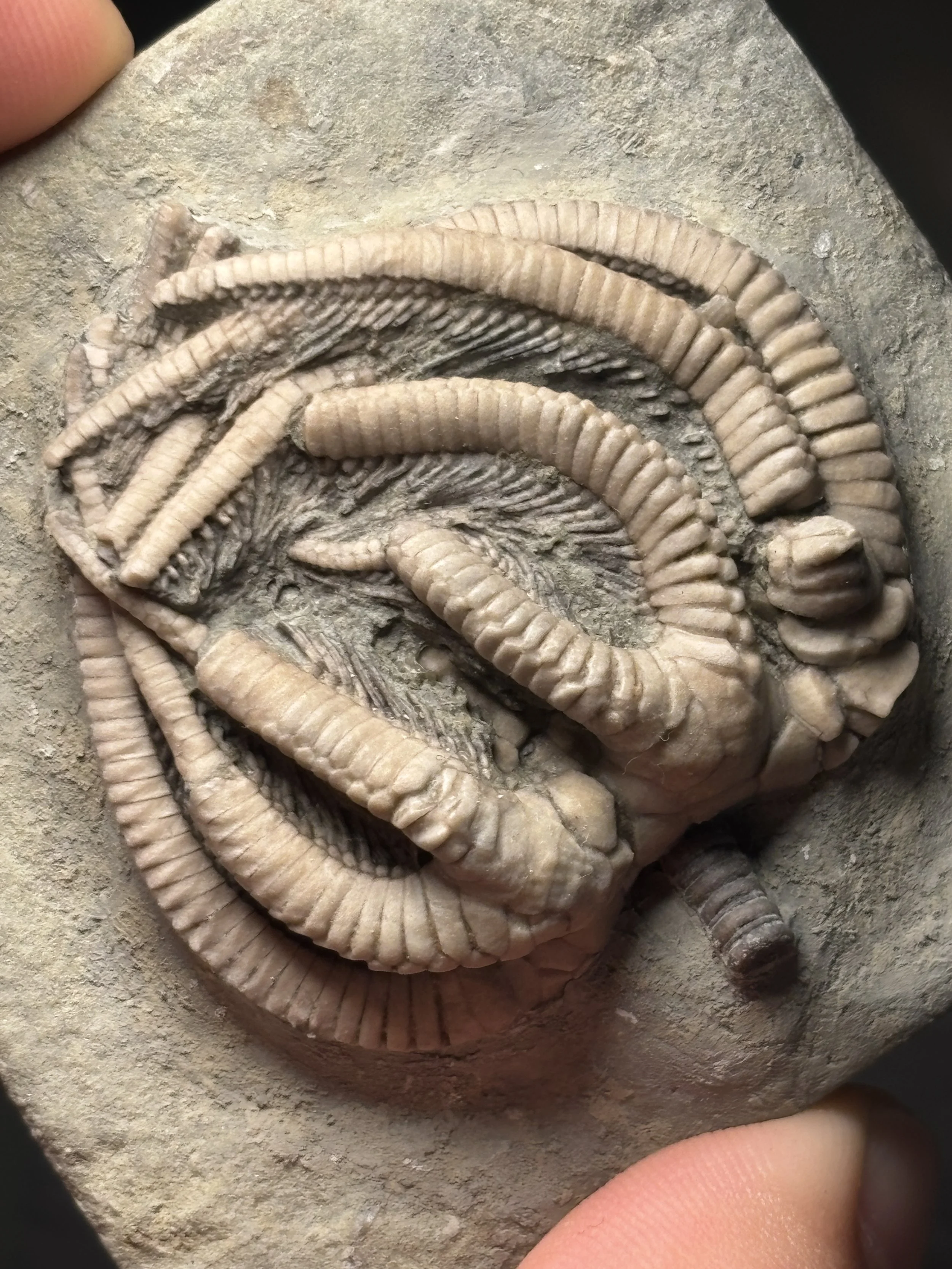
Agariocrinus americanus 46mm, Crawfordsville, Indiana, Edwardsville Formation, Carboniferous, Mississippian (358.9 to 323.2 million years ago)
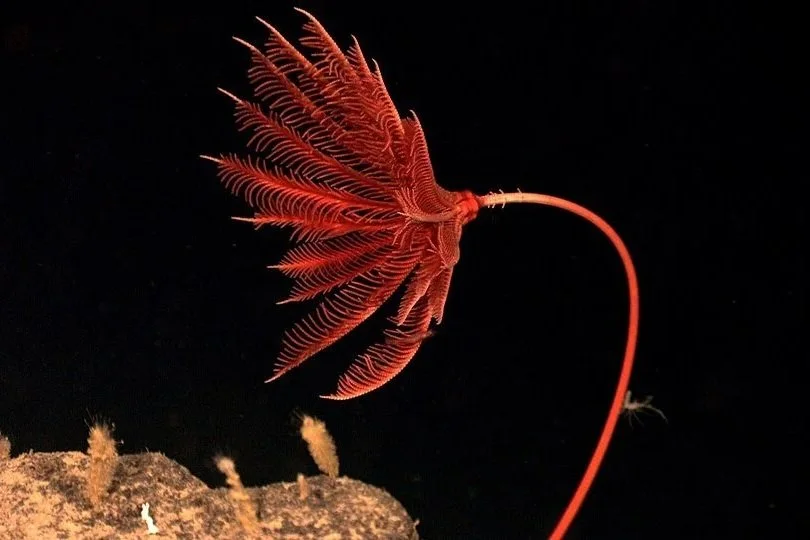
Modern Proisocrinus ruberrimus crinoid, NOAA Photo Library, CC BY 2.0 <https://creativecommons.org/licenses/by/2.0>, via Wikimedia Commons
Commentary on Living Fossils:
As a kid, I read about these mystical “living fossils” or animals that pop culture claimed to have defied the laws of evolution and stayed the same for over millions of years. As I delve deeper into paleontology, living fossils become more and more fascinating not because they actually refused to evolve after millions of years and multiple mass extinction events, but because they represented a distinct lineage of animals that survived extinction after extinction and still emerged looking like something out of a slab of rock. Compared to the most notable examples of “living fossils” like the Coleacanth; a representative of a lobe finned fish (Sarcopterygii) long thought to be extinct, the Tuatara; an example of an ancient order of reptiles that thrived during the dinosuar age, and the Nautilus; a critically endangered example of early shelled cephalopods that emerged around the Jurassic, the Crinoid; a marine invertebrate that emerged from the Early Ordovician 485 million years ago, is a class of animals that remains relatively unknown compared to its other more celebrity “living fossils.”
A Look at Ancient Crinoids from the Carboniferous, Mississippian (358.9 to 323.2 million years ago):
The North American fossil record is incredible in the sense that these incredibly preserved examples of invertebrates are oftentimes commercially available for museums of all sizes to disseminate information to the public and for private collectors to hold in their hands while reading up on the latest research done by prominent paleontologists.
After the events of the Devonian Mass Extinction due to rapid global cooling, the deoxygenation of oceans, and mass volcanic eruptions, 70-82% of all marine life died off. This marked the beginning of the Carboniferous period known for its massive forests and extremely high oxygen levels that produced the majority of the world’s coal deposits and enormous insects that grew from the oxygen deposits. The implications for ocean life are often neglected in documentaries about the Carboniferous, but Crinoids thrived in this newfound environment featuring warm, shallow inland seas and an abundance of microscopic plankton. Additionally, the conditions of the Devonian extinction nearly wiped out the coned cephalopods, early placoderms, and nearly all other predators that reigned freely in the seas of the Devonian. The Crinoids that remained saw a peak in biodiversity during the Mississippian (early Carboniferous) as the forces of evolution forced them to fill in the biological niches that other animals previously occupied.
Agariocrinus americanus, Edwardsville Formation environment:
Agariocrinus americanus, known as the mushroom crinoid or American crinoid, is representative of the rich diversity of well preserved Carboniferous crinoids from Crawfordsville, Indiana’s Edwardsville Formation. The conditions of the Edwardsville formation represented a shallow, fine silt environment that frequently overfilled from the nearby delta. In addition to being a haven for the advanced crinoids during this time period, the frequent, rapid burials meant that soft body parts were oftentimes preserved. The Edwardsville formation is famous for its complete examples of crinoids that showed all parts of a crinoid’s body structure, looking remarkably similar to its modern counterparts.
Diagram of Crinoid Body Structure and Reconstruction of Carboniferous Crinoid Habitats:
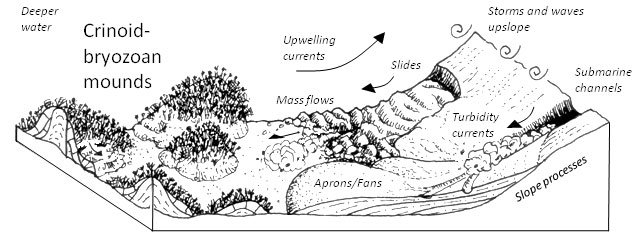
Greb, S.F., Potter, P.E., Meyer, D.L., and Ausich, W.I., 2008, Mud mounds, paleoslumps, crinoids, and more; the geology of the Fort Payne Formation at Lake Cumberland, south-central Kentucky: Field trip for the Kentucky Chapter of the American Institute of Professional Geologists, May 17-18, 2008: 45 p.
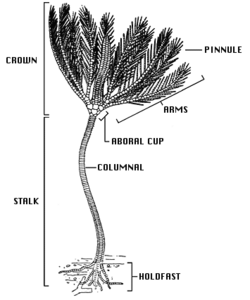
Crinoid Body Structure, William I. Ausich, CC BY 3.0 <https://creativecommons.org/licenses/by/3.0>, via Wikimedia Commons
