Review of Struveaspis sp.
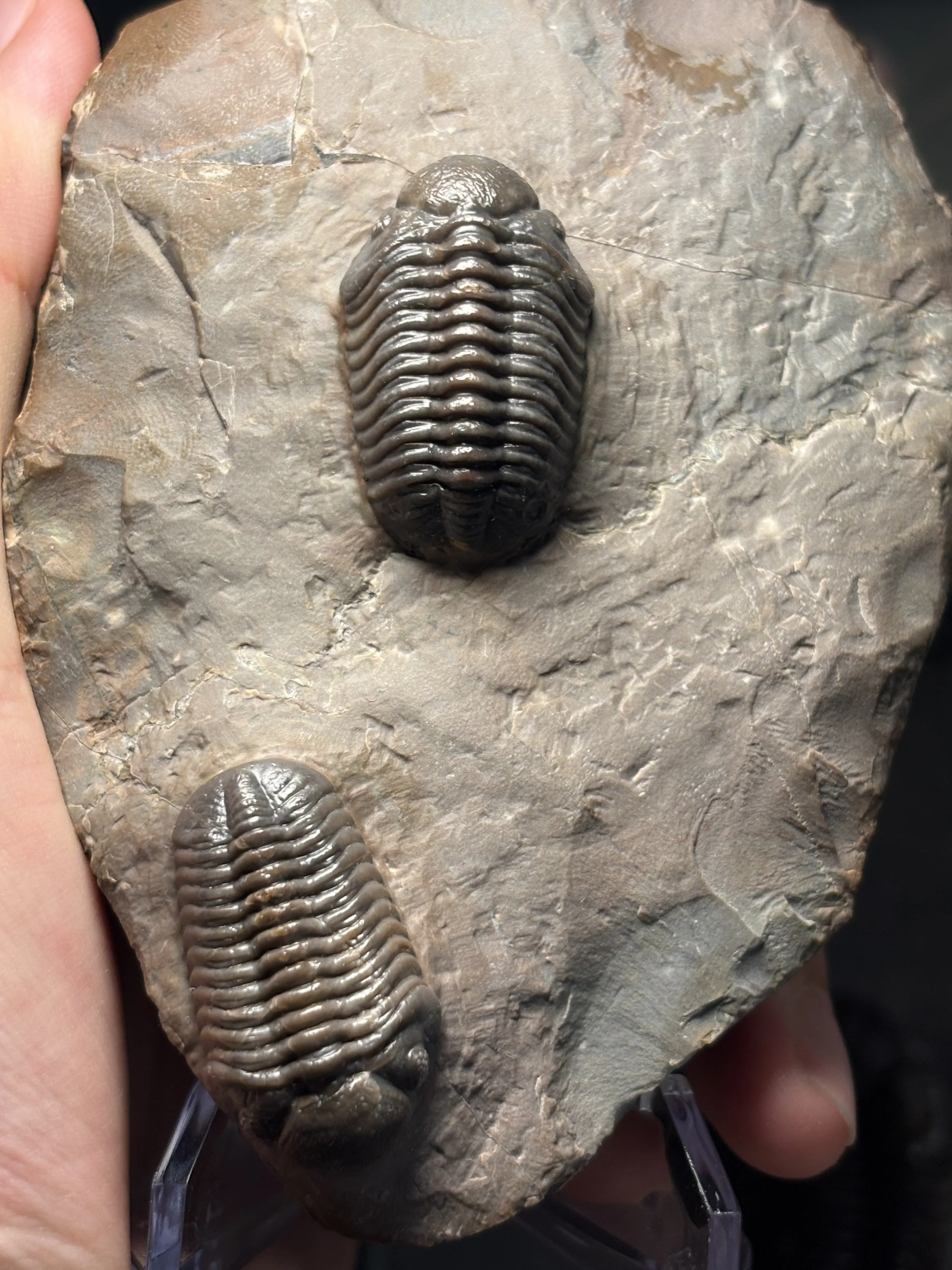
double trilobites (31mm, 34mm) in hard, quartzite matrix: a signature of the Jorf, Morocco Tafilalt region
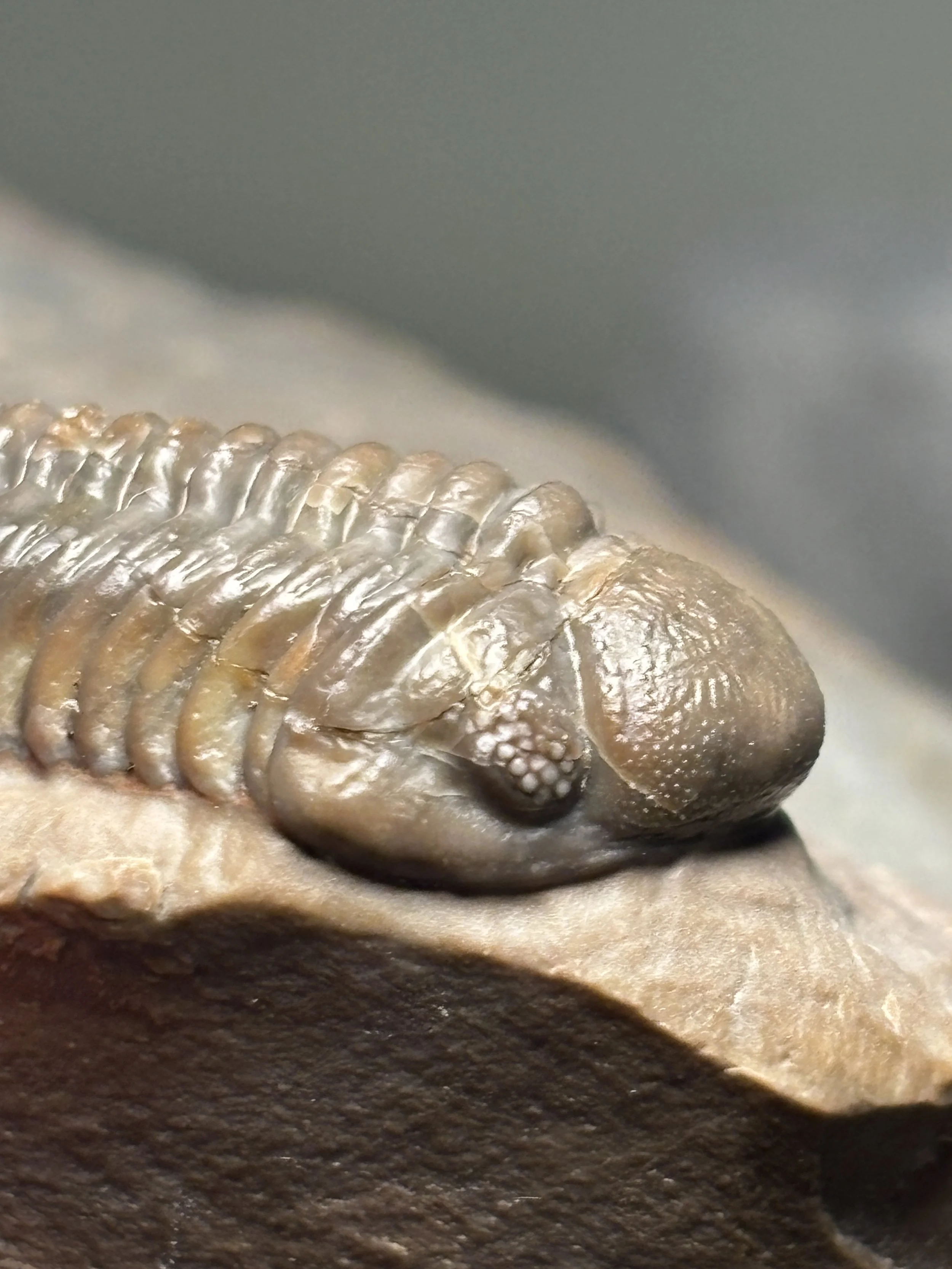
angle highlighting the pustules of the large glabella, oftentimes not preserved from this locale
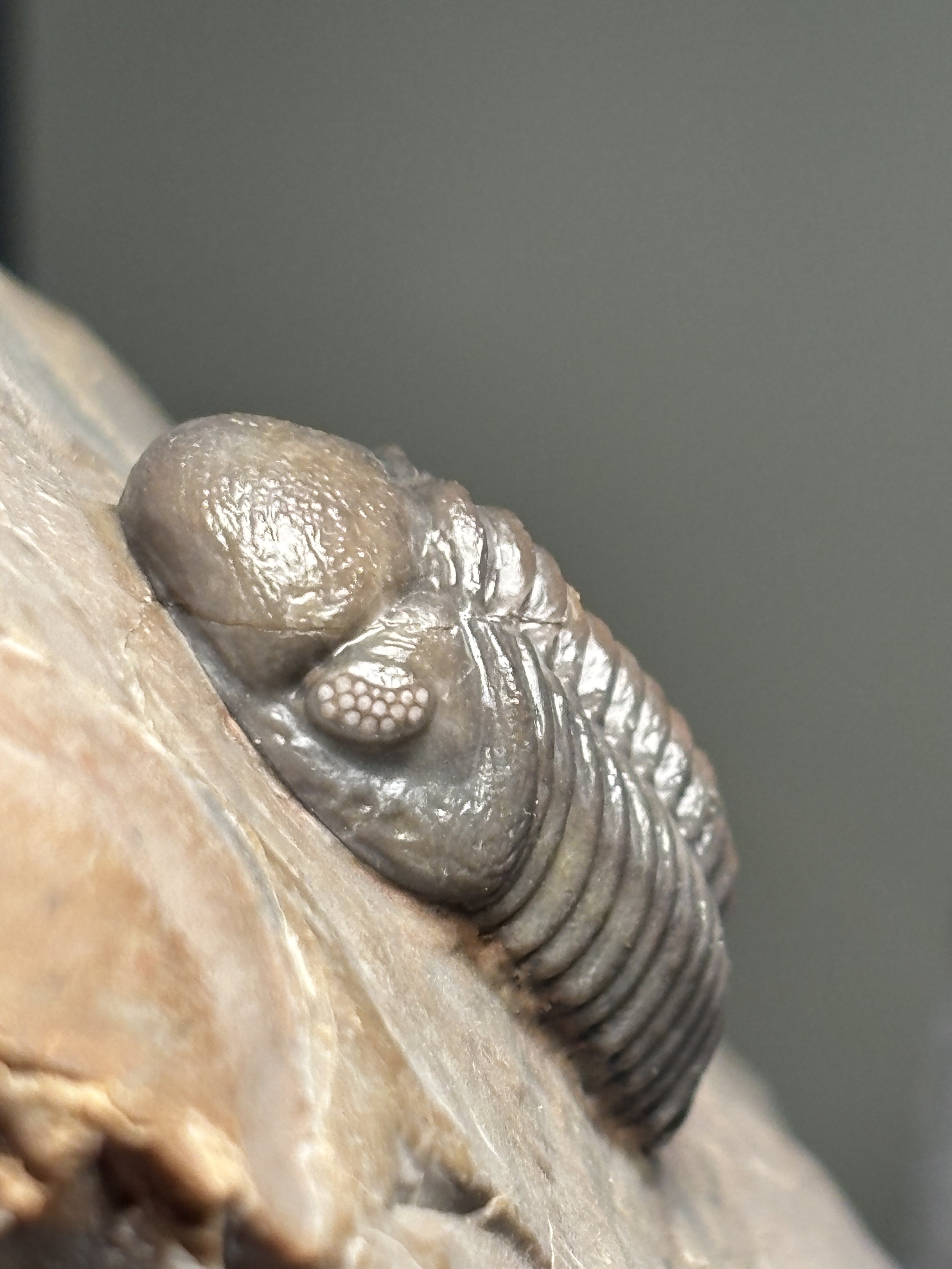
Struveaspis sp. are known for their dimunitive lens count in comparision to other phacopids
Stuveaspis’ Distinct Eyes:
The genus Struveaspis is a type of trilobite within Phacopidae found throughout the middle Devonian time period 393 to 382 million years ago. These phacopids are known for their pronounced glabella containing the feeding organs of the trilobite (hypostome), and their dimunitive Schizochroal eyes found exclusively within Phacopidae. Schizochroal eyes are distinct in certain trilobites. Compared to Holochroal eyes in most trilobites and modern arthropods that sport a single corneal lens cover and thousands of tiny individual lenses, Schizochroal eyes contain fewer, much larger lenses. Struveaspis, notably, is a genus within Phacopidae that is often highlighted for having an abnormally low count of individual lenses, indicative of the lower light environment it likely habitated.
Description of Geologic Formation:
The specific specimen shown above from my personal collection is likely an undescribed species of the genus from Jorf, Erfoud Morocco, Bou Tchrafine Formation. The 15 meter thick geologic formation is unique compared to other localities in the fossil-rich country of Morocco because it does not possess distinct layers of deposition. Instead, the formation represents metamorphic quartzite rather than sedimentary shale, representative of a volcanic deposit that formed from mudslides. As a result, the fauna found in this formation are extremely difficult to prepare even with the presence of high-quality air scribes (mechanical tools that use pressurized air and microscopic sand-substances to blast away rock). It it likely that most of the pustules, tiny spines, and other details on a trilobite’s exoskeleton are lost in the preparation. Additionally, trilobites that emerge from this locale are colorful as they are comprised of transparent quartz rather than calcite or aragonite, and take up the color from the matrix.
The prevalence of several species from this locale is especially intriguing, and the next section will delve into the recently described species: Struveaspis bignoni to explain whythe specimen in the images is likely undescribed.
Summary and Analysis of Academic Article:
Struveaspis bignoni, described in 2013 and named after the late paleontologist Dr. Arnaud Bignon, represents a scarcer body of research into Devonian trilobites from Morocco in general. As the most commercially successful and most diverse countries for trilobites in general, the general body of research that exists for trilobites from this origin are dated and oftentimes scarce. Species from Morocco are oftentimes undescribed, newly discovered, or constantly updated as paleontologists find distinct morphological differences. Additionally, in most of these papers from the middle 20th century, the literature is French as Morocco was once a French territory. The paper below is written in Spanish which took some of my Spanish skills and online translating to dissect: a fun endeavor.
Joan Corbacho, a paleontologist at the Museo Geológico del Seminario de Barcelona, Spain, details the morphological distinctions of the recently described Struveapsis bignoni found in the same locale as the specimen from my personal collection. The distinction for this new species is the fact that the pygidium (tail part of the trilobite), lacks pleural ribs and lobes (the distinct lines that comprise of a trilobite’s exoskeleton). The pygidium is almost entirely smooth which is an attribute that can best describe the new species in its entirety: smooth and flat (Gorbacho 1). The distinct dimunitive eye-count is also notable for S. bignoni, but is not as prevalent in other already described species like S. maroccanica (Gorbacho 3).
My specimen also has a dimunitive eye count, but it has significantly less lenses compared to most examples of S. bignoni. The thorax possesses a total of 11 segments, which is the same as S. bignoni. However, the most important distinction is the presence of visible segmentation on the pygidium in both specimens which deviates from the literature description of S. bignoni. Therefore, it is reasonable to conclude that the specimen in my collection is likely undescribed or that of another species described in earlier literature.
Works Cited:
Corbacho, Joan. (2014). Struveaspis bignoni: Nueva especie de Phacopidae (Trilobita) de Marruecos; Devónico medio (Eifeliense). 16. 3-12.
