Schizochroal Eyes in Trilobites
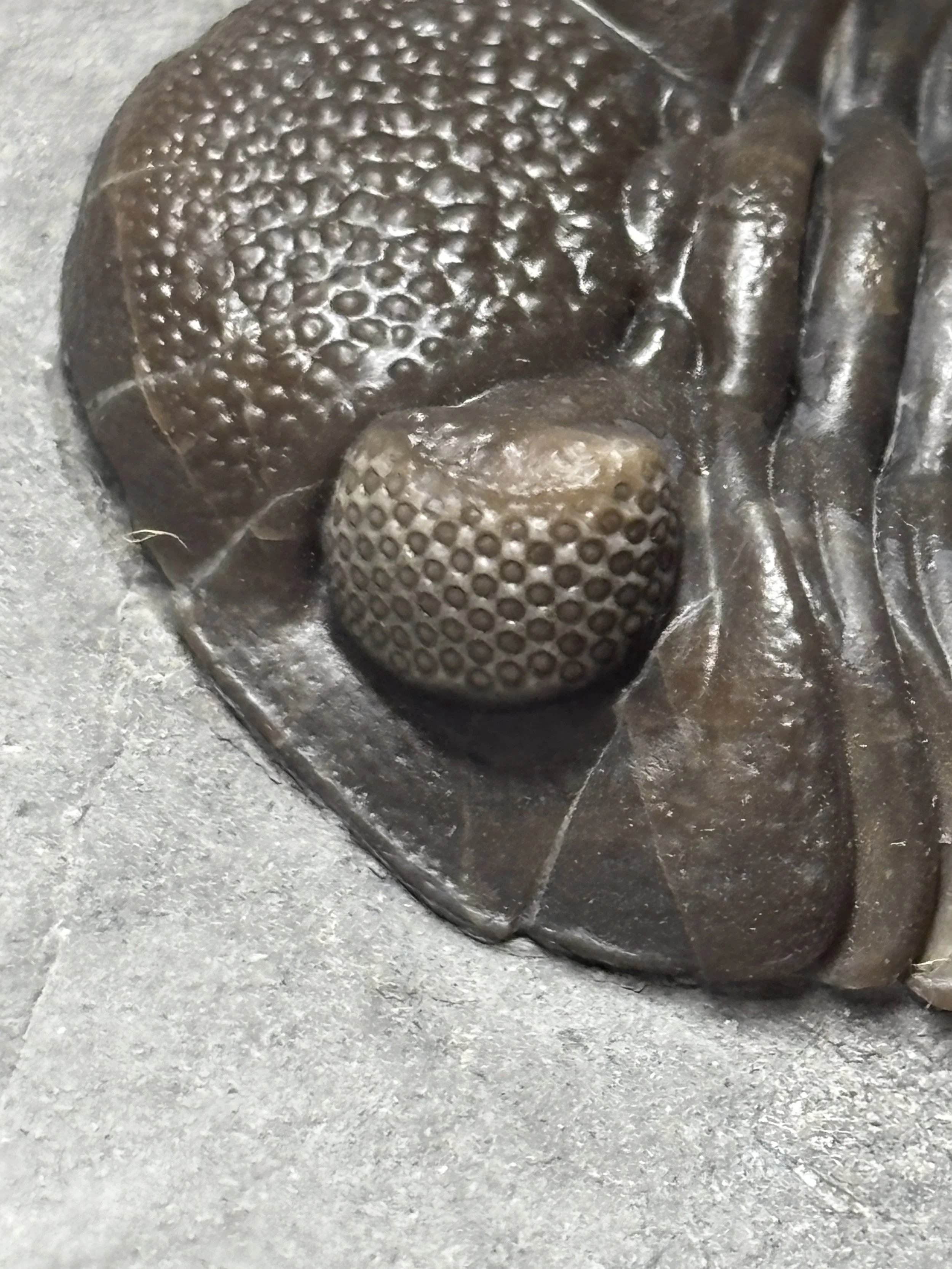
Known as the frog-eyed trilobite, Eldredgeops is known for its large, prominent Schizochroal eyes
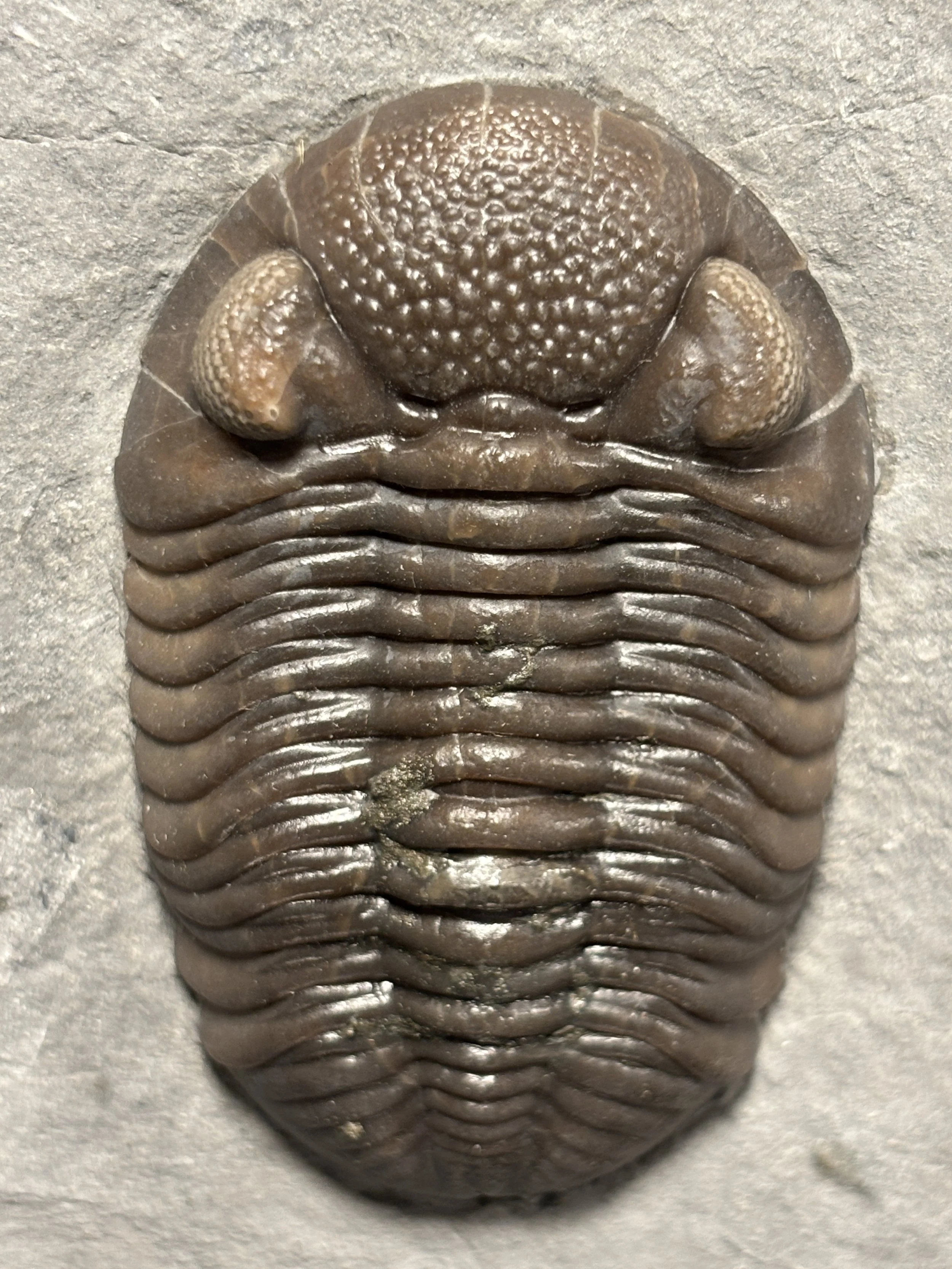
Prone specimen of Eldredgeops rana crassituberculata (61mm), Paulding, Ohio, Silica Formation
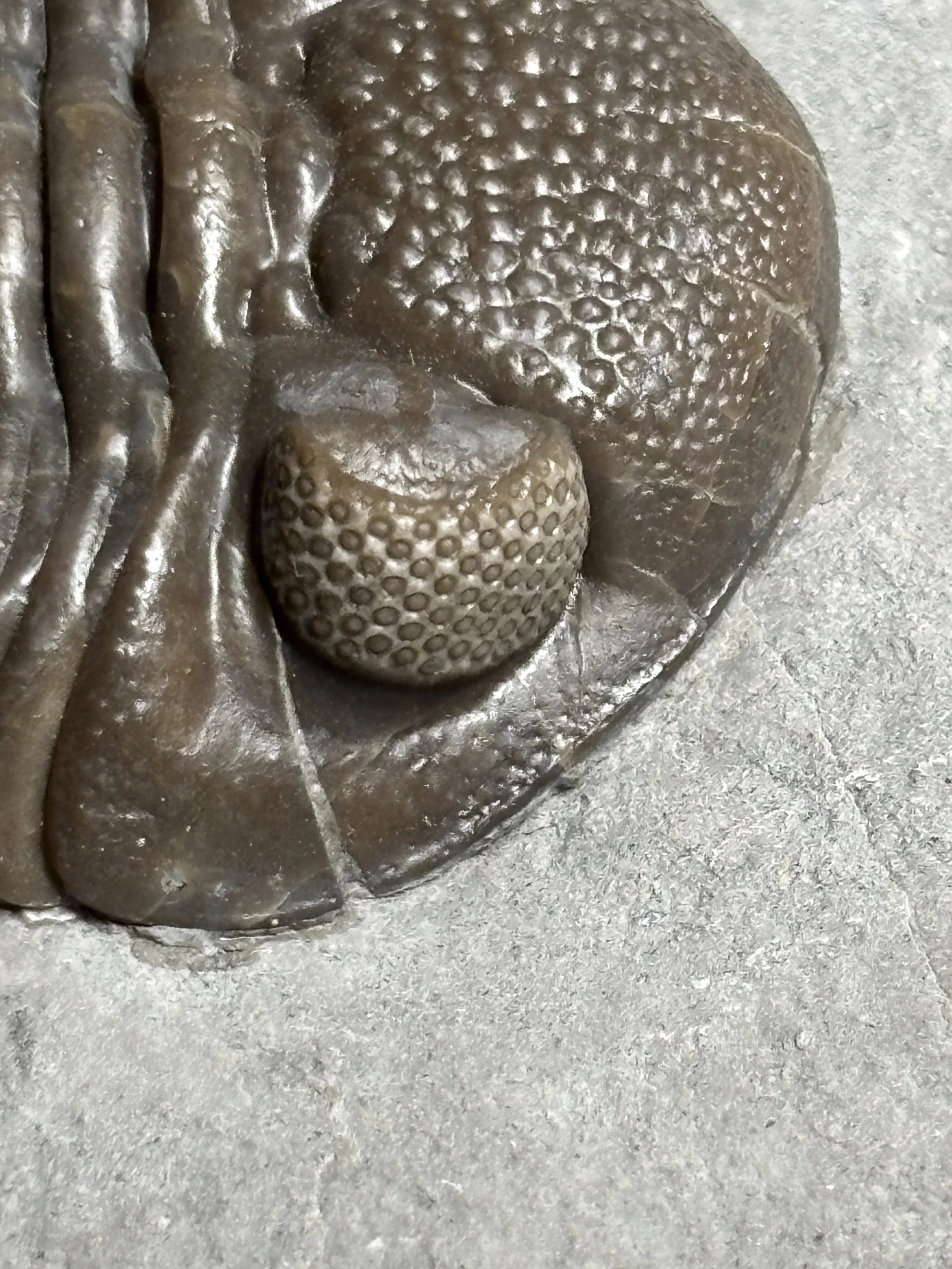
Trilobites had solid, crystalline calcite eyes meaning they possessed the most advanced vision during the Middle Devonian
Introduction to the Trilobite Vision:
Trilobite eyes were crystalline and solid, meaning that unlike human eyes, they cannot expand and contract to adapt to various environmental cues. Humans, like most mammals possess simple eyes with photo receptors concentrated in a single retina. Complex eyes on the other hand had hundreds to thousands of individual eyes each possessing separate photo receptors. The eyes combined into a complex mosaic to form a more complete image in the animal’s head. The trilobites are a notable example of early vision that was accurate to the environment around them. Trilobites had two forms of early complex eyes: Schizochroal and Holochroal eyes
Differences between Schizochroal and Holochroal Complex Vision:
Schizochroal eyes contains fewer, much larger lenses that each possessed their own cornea cover while each individual eye was divided by a thick, solid wall called the sclera. Holochroal eyes were more like those of modern arthropods: they possessed thousands of lenses covered by a single, large cornea.
The Phacopina Suborder and Eldredgeops rana crassituberculata
Only trilobites within the Phacopina suborder possessed Schizochroal eyes. Eldredgeops rana crassituberculata, a member of this suborder, is notable for its prominent Schizochroal eyes and widely studied for them. This subspecies has an especially robust glabella (head portion protecting the trilobite’s feeding organs) and sports large eyes to scan the sea floor for potential predators and prey. Due to the prominence of these features, paleontologists have hypothesized that the subspecies was an active predator that lived in a complex, archaic early coral reef ecosystem inhabited by a variety of early sea creatures.
Unique Attributes of Schizochroal Eyes:
Specifically, Schizochroal eyes possessed two separate calcite lenses within each of their eyes that possessed different refractive qualities (Cowen & Kelley 1). The “aspherical structure meant that the lenses were correct for aspherical aberrations” (Cowen & Kelley 1). This meant that those within the Phacopina suborder were able to see clearly without any visual distortions based on distance. The aspherical structure corrected for any blurriness and meant that the mosaic formed by each eye offered a clear image.
Trilobite Vision in the Context of the Middle Devonian:
The middle Devonian time period, known as the “Age of the Fishes,” was filled with large predators that evolved new ways to hunt. The large shelled cephalopods that were prominent during the Ordovician before still ruled the seas possessing sharp beaks that were able to crush the shelled defenses of trilobites. However, new early armored fishes called Placoderms were the new apex predators of the ecosystem; they possessed early forms of jaws which they used to crush the hard shelled defenses of trilobites and cephalopods alike. Phacopina grew to prominence during this time period with an diverse variety of species sporting Schizochroal eyes to avoid predators. Furthermore, trilobites in other families evolved complex spines and robust shells to fend off against these new predators.

Middle Devonian Coral Reef Diorama, James St. John, CC BY 2.0 <https://creativecommons.org/licenses/by/2.0>, via Wikimedia Commons
Works Cited:
COWEN, R., KELLEY, J. Stereoscopic vision within the schizochroal eye of trilobites. Nature 261, 130–131 (1976). https://doi.org/10.1038/261130a0
Laird, Isabella. “Trilobite Eyes Have Lenses Made of Calcite.” Beaty Biodiversity Museum, The University of British Columbia, 26 Oct. 2017, https://beatymuseum.ubc.ca/2017/10/26/trilobite-eyes-are-hard/.
