Trilobite Preparation Sequences
Trilobites are notoriously hard to prepare even with the best pneumatic tools available. Their tiny sizes (often a few millimeters), tiny morphological pustules and spines, and compound eyes mean that they are best prepared under a microscope. With my rotary tools, they become nearly impossible to prepare without damaging the fossil or reaching a thin layer of limestone that just will not budge. Even so, I have tried my hand at preparing trilobites using rotary tools. One day, I hope to finish them when I am able to invest in a pneumatic tool setup.
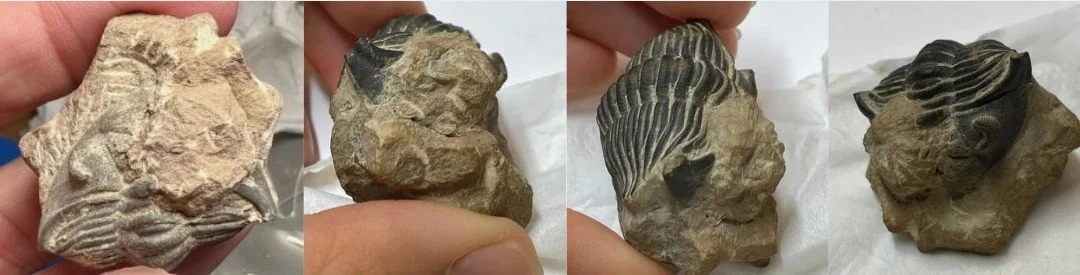
Unprepared Middle Devonian Hollardops mesocristata from Hamar Laghdad Fm, Alnif, Morocco. Moroccan trilobites are best prepared with air/pneumatic tools. Typical hard mineralized chert matrix-a signature for Moroccan trilobites and difficult to work with. Used high-torque settings on rotary tool to chip away at matrix.
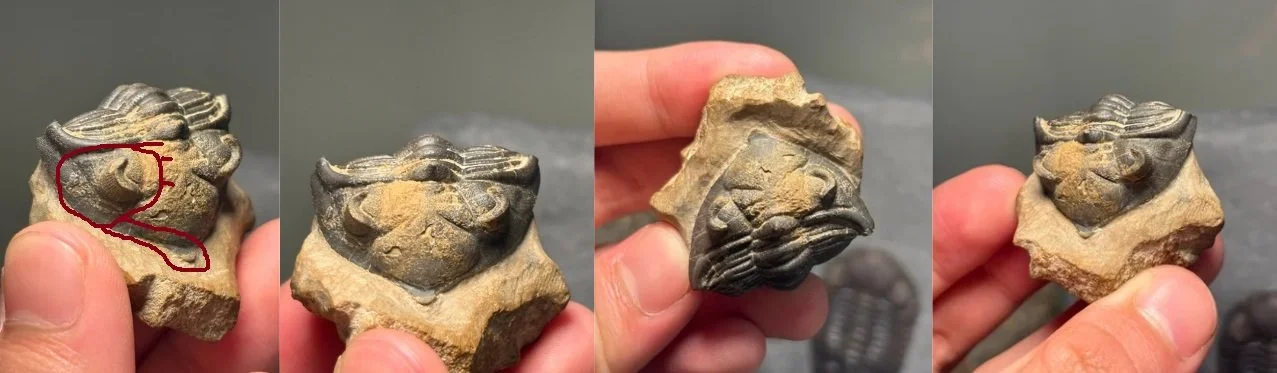
Prepared Hollardops mesocristata missing genal spines. Was a welcome surprise uncovering the eye of the trilobite without damaging it. Further preparation of ochre area would almost certainly damage the glabella of the trilobite, left as is. Total preparation time ~25 hours.
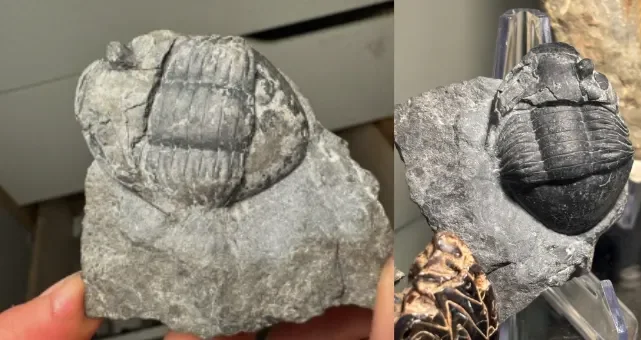
Early Ordovician Liomegalaspides hupeiensis trilobite from Dawan Fm, Hubei, China; prepared using rotary tools on low torque settings. Matrix was an eroded calcitic shale and easy to work with. Coated with a thin layer of stabilizing adhesive as shell on glabella started flaking away. Total preparation time~7 hours.
